


Agriculture Automation
INTRODUCTION
When Cary Grant took on a crop-dusting plane in North by North-West, it was clear that, while the plane managed to cover him in crop dust, it was otherwise relatively indiscriminate in its application. For many years, that was acceptable. Whether pesticides or fertilisers, their application was not targeted, resulting in excess use and runoff, which is not acceptable today.
This is part of the automation trend in agriculture driven by several factors, in no particular order:
- Increasing cost of materials such as fertilisers and pesticides
- Increasing monitoring of waste, contamination, and runoff of materials from where they are required
- Increasing difficulty in recruiting and retaining staff
All of these factors are driving further automation in agriculture: a need to carry out tasks with greater precision and reduced labour.
Automation is appearing everywhere in agriculture. Consider the following case studies:
CASE STUDIES
Case 1- Mushroom Picking Automation
Challenges:
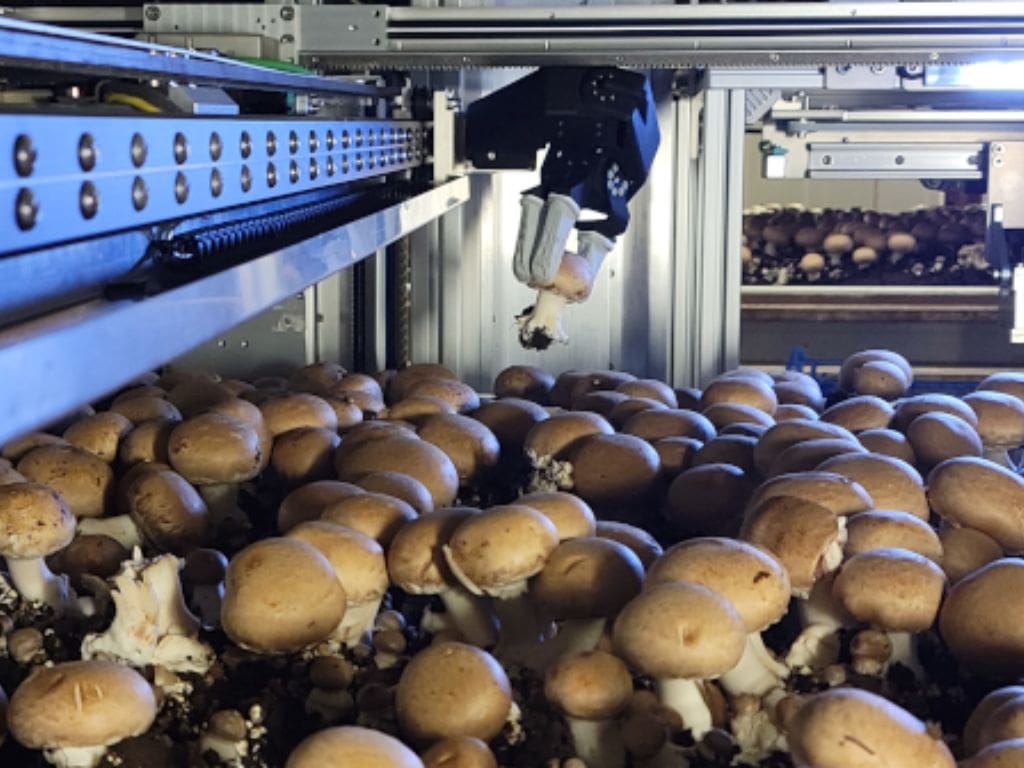
Picking mushrooms is a labour-intensive task. Mushrooms have an irregular growth pattern, complicating the process. Labour costs can be high, and there are health and safety issues, as workers risk falls and injuries when dealing with shelves of mushrooms at various heights. Mushroom farmers need a new approach to their industry.
Solution:
To address these challenges, the mushroom picking process can be automated using a robotic arm. This will efficiently and precisely pick and place mushrooms, minimising human error and reducing labour costs. The robotic arm is equipped with sensors and programmed algorithms to identify and handle mushrooms delicately, ensuring high-quality harvests. With this automated solution, productivity can be enhanced, consistency maintained, and overall operational efficiency improved.
We found a solution by powering the robotic arm with a harmonic rotary actuator, specifically the MAT series, featuring an enlarged hollow shaft. This rotary actuator includes a mounting flange and offers optional colour anodisation. It comes with three gear ratios: 51, 101, and 161, and hollow shaft diameters ranging from 26 to 45mm. Additionally, it is equipped with an incremental or absolute encoder, multi-turn capabilities, and an optional holding brake. The actuator also boasts up to IP67 protection.
Customer Benefits:
The benefits of this change are substantial. By using robotic arms for automated mushroom picking, operational expenses and reliance on manual labour are significantly reduced. Health and safety conditions are greatly improved by minimising the risk of falls and injuries associated with picking mushrooms at elevated heights. Additionally, the customization and flexibility offered by the enlarged hollow shaft and adjustable features like gear ratios and encoders allow for tailored solutions that meet specific requirements. Furthermore, the system's scalability and adaptability enable it to be easily adjusted to different farm sizes and various mushroom varieties.
Case 2- Rotary Parlour Application
Rotary parlours allow cows to be milked while riding on a large turntable. They claim greatly increased efficiency and a more comfortable experience for the cows. The staff have easier access to the animals in the event of any problems. These are now common in dairy farms, with 250 in the UK alone, and large applications in countries such as the USA and Australia. Rotary parlours are highly automated, requiring power and signals to be transmitted to the rotating device. They also present a harsh environment with durability concerns. At Motion Control Products, we have specified slip rings, which allow the transmission of power and signals in continuous rotation without connection problems. Due to the harsh, damp environment and the presence of dairy chemicals, we’ve specified slip rings using corrosion-resistant stainless steel for durability.
The slip ring consists of two parts: an external STATOR, which is normally stationary, and an internal ROTOR, which rotates. The operation is reversible, allowing the external part to rotate and the internal part to be fixed. For this application, we chose the ER "Hollow Shaft" range of slip rings. These slip rings resist corrosion from dairy chemicals and handle high power levels for smooth parlour operation. They can transmit multiple signals, including digital, analogue, and fieldbus, such as Ethernet real-time protocols. They are reliable and perform well in harsh industrial environments, with through-hole diameters ranging from 12.7mm to 700mm.

Case 3- Use of Drones in Agriculture

Drone crop spraying is a relatively new approach to applying pesticides and fertilisers. The use of drones allows much greater control and flexibility. They can use aerial imagery and 3D mapping to identify areas that require application and then apply the materials in a highly targeted manner. It is even possible for a camera-equipped drone to identify a single plant with a nitrogen deficiency and apply the required amount of fertiliser. The savings in materials, waste, and runoff, combined with increased productivity, become very significant. At Motion Control Products, we have extensive experience supplying motors, drives, and other components for specialised drones of various sizes.
Conclusion
As agriculture continues to evolve, automation is proving to be a vital component in enhancing efficiency, reducing costs, and improving safety. From drone crop spraying to rotary parlours and robotic mushroom picking, the integration of advanced technologies is transforming traditional farming methods.
At Motion Control Products, we are committed to providing innovative solutions that meet the diverse needs of the agricultural industry, ensuring sustainable and productive practices for the future. Please watch our YouTube video to explore our product ranges relevant to your agriculture automation needs and applications. If you need any further assistance, please contact our technical team at (+44) 01202 599922 or via email at [email protected].